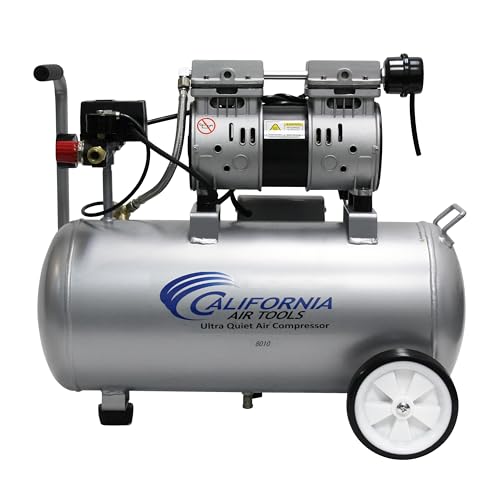
The California Air Tools 8010 is the compressor to look at when noise and weight matter more than raw airflow. It pairs a 1.0 HP motor with an 8-gallon steel tank and an oil-free dual piston pump, and the maker rates it at 60 dB and 48 lbs. The maker says it is ideal for anyone working indoors where noise is a major issue. This profile covers what California Air Tools lists, how to read the numbers, who the 8010 suits and where it falls short. To see how it sits beside the others, read our air compressor ranking for 2026.
On sources: the figures below come from the maker’s own product page and specification sheet, listed at the end. We do not take specs from retail listings.
According to the product page and the specification sheet:
- Motor: 1.0 HP rated and running, 2.0 HP peak, running at 1,680 RPM. The maker says the lower speed means less noise and less wear.
- Pump: oil-free dual piston, designed for a life cycle of more than 3,000 hours before wear.
- Tank: 8 gallons, steel.
- Air delivery: 3.10 CFM at 40 PSI and 2.20 CFM at 90 PSI.
- Pressure: 120 PSI maximum.
- Noise: 60 dB.
- Electrical: 110 volts, 60 Hz, 8.5 amps maximum current. The maker lists a 2,500-watt (running) generator as the minimum to run it.
- Fill and recovery: 165 seconds from empty to full, and 60 seconds to recover from 90 to 120 PSI.
- Duty cycle: 70/30.
- Size and weight: 26 by 14 by 23 inches and 48 lbs, with a wheel kit.
- Other: two pressure gauges, one industrial push-to-connect quick connector, a thermal overload protector and an air filter. UL/CSA certified.
- Warranty: 1 year, limited.
Reading the Numbers
The airflow is modest. At a listed 2.20 CFM at 90 PSI, the 8010 sits below the 2.8 CFM of the Metabo HPT EC711S and well below the 5.30 CFM of the 20-gallon California Air Tools 20020. That should be fine for tools that use air in short bursts: brad and finish nailers, staplers, tire inflators, air ratchets used briefly and blow guns. It is not meant for a sander, a die grinder or a spray gun that wants air continuously. Check the CFM figure on each tool’s label or manual and keep some margin.
The 8-gallon tank helps. More stored air than a small pancake gives the pump more time to rest between bursts. The maker lists a 70/30 duty cycle, which describes how much of a cycle the motor is designed to run, and a 60-second recovery from 90 to 120 PSI.
60 dB is the quiet figure. Decibels are logarithmic and makers measure differently, so compare these figures as rough guides. Still, California Air Tools lists 60 dB for the 8010, 70 dB for the 20020 and 56 dB for the 1.0-gallon 1P1060S. The Metabo HPT EC711S lists 73 dB and the CRAFTSMAN CMEC6150K lists 78.5 dBA. If you work in an attached garage, a basement workshop or a shared space, the 8010 is a sound pick. It is still a compressor, and you will still hear it.
8.5 amps is light. The maker lists 8.5 amps, which is less than the 14 amps for the 20020, so it is a better fit for a garage with a shared circuit. Even so, a compressor motor draws more current as it starts, so keep any cord short and heavy-gauge, avoid sharing the circuit with a heater or a freezer, and ask a licensed electrician about any wiring you are unsure of.
Oil-free means easy care. There is no oil to change. The maker asks you to replace the air filter every two years, or every year if the compressor sits in a dirty or dusty space. Drain the tank after use.
At 48 lbs, it is movable. It has a wheel kit and weighs less than half as much as the 20020, though the 38.5-lb Metabo HPT EC711S is lighter still. You can roll it out of a corner, but lifting 48 lbs into a car trunk takes some effort.
Who the 8010 Suits
This compressor fits you if:
- You work in an attached garage, a basement or a workshop where noise matters.
- You run nailers, staplers or air tools in short bursts, or you inflate tires, balls and toys.
- You airbrush or do small paint jobs that do not run for long.
- You want an oil-free pump and a light, wheeled design.
Who Should Look Elsewhere
- You run tools that consume air continuously. Step up to the 20-gallon California Air Tools 20020 or a Makita. The Makita MAC5200 lists 6.5 CFM at 90 PSI.
- You need to feed two nailers. Makita says its Big Bore models can.
- You need the smallest size. The 1-gallon California Air Tools 1P1060S is lighter at 29 lbs and lists 56 dB, with less airflow.
- You want accessories in the box. The 8010 lists a wheel kit and an air filter, and it is not sold as a hose-and-accessory kit like the CRAFTSMAN CMEC6150K. California Air Tools sells a 16-piece hose and accessory kit and a 25-foot hybrid hose as separate add-ons.
Before You Buy
- Match tool CFM. Compare each tool’s CFM at 90 PSI with 2.20.
- Confirm the model. California Air Tools also sells variants, such as an 8010 with an automatic drain valve and an aluminum-tank version. The steel-tank 8010 is the one in this profile, so check the listing title.
- Plan for a hose. The maker lists accessories as add-ons.
- Read the warranty. It is a 1-year limited warranty, and commercial users should refer to state and city codes.
Care and Safety Basics
Drain the tank after use and release pressure before servicing. Wear eye protection with a blow gun. For cleaning with compressed air at work, OSHA’s 29 CFR 1910.242(b) limits it to under 30 psi with chip guarding and protective equipment. It is an employer rule, but a good habit at home too. If you plan to inflate tires, use a gauge you trust. Our garage compressor guide puts sizing, circuits and noise together.
Bottom Line
The 8010 is the quiet, light, low-amp choice among our larger compressors, and airflow is the trade-off. For nailers, inflation and light work in shared spaces, it is easy to live with. For big tools, move up a size.
See price on Amazon
Sources