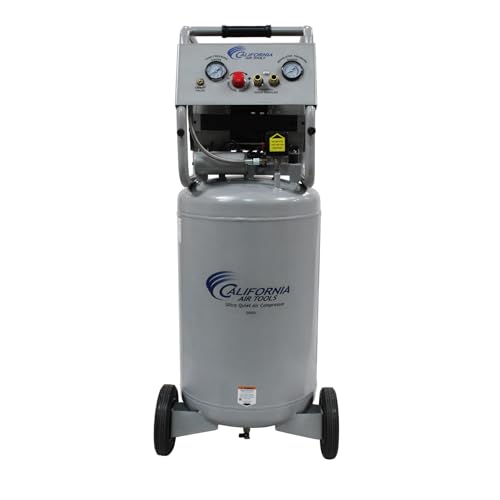
The California Air Tools 20020 is a big, relatively quiet compressor aimed at people who want to run real air tools in a home garage or small shop without the racket of a traditional oil-lubricated unit. It pairs a 2.0 HP motor with a 20-gallon steel tank and an oil-free dual piston pump, and the maker rates it at 70 dB. This profile covers what California Air Tools says about the machine, how to read those numbers, who it suits and where a different model would serve you better. For how it compares with the rest of the field, see our air compressor ranking for 2026.
A note on sources: every figure below comes from the maker’s own product page and specification sheet, both listed at the end. We do not quote retailer listings for specs, and where the maker is silent, we say so.
According to the product page and the specification sheet:
- Motor: 2.0 HP, running at 1,680 RPM. The maker says the lower speed means less noise and less wear.
- Pump: oil-free dual piston. The maker says it is designed for a life cycle of more than 3,000 hours before wear.
- Tank: 20 gallons, steel, listed as non-ASME.
- Air delivery: 6.40 CFM at 40 PSI and 5.30 CFM at 90 PSI.
- Pressure: 125 PSI maximum, working pressure 90 to 120 PSI, and a 90 PSI default regulated output.
- Noise: 70 dB.
- Electrical: 110 volts, 60 Hz, 14 amps maximum current. The maker recommends a dedicated 15 amp outlet with a 14-gauge, 25-foot cord.
- Fill and recovery: 4 minutes to fill from empty to full, and 1 minute to recover from 90 to 120 PSI.
- Duty cycle: 70/30, with maximum continuous running of 60 minutes depending on pressure and CFM.
- Weight: 114 pounds on the specification sheet and 115 on the product page. We say “about 115 lbs” for that reason.
- Other features: Easy Start Valve, two pressure gauges, two industrial push-to-connect quick connectors, a pressure switch, a thermal overload protector, two no-flat wheels with a handle, and two air filters.
- Warranty: 1 year, limited.
Reading the Numbers
CFM at 90 PSI is the number that matters. Air tools list how much air they consume at 90 PSI. A compressor has to supply at least that much on a continuing basis, or the tool will lose power and the pump will run constantly. At a listed 5.30 CFM at 90 PSI, the 20020 lists more airflow than any of the pancake models on this site. It should suit tools that use air in bursts: impact wrenches for a wheel change, ratchets, brad and finish nailers, staplers, blow guns and inflators. Tools that consume air continuously, such as a die grinder, a sander or an orbital polisher, are a closer call. The maker’s own wording is that the large tank is meant to store air for “higher demand air tools such as spray guns and sanders.” Check the CFM figure for the specific tool you plan to use and leave some margin.
The tank gives you quiet stretches. A 20-gallon tank holds a good reserve, so for intermittent work the motor can stay off while you use stored air, then refill. The maker lists 4 minutes to fill from empty and a 70/30 duty cycle, meaning the motor is designed to run about 70 percent of a cycle and rest for the remainder. If a job keeps the pump running without a pause, expect it to run often. Long run times also heat the machine, which is why the maker lists a thermal overload protector.
70 dB is quiet for a compressor this size, not silent. Decibels are logarithmic, and measurement distances differ between makers. Treat 70 dB as the maker’s claim: California Air Tools credits the machine’s lower motor speed for its quieter running. In an attached garage, a compressor that cycles on while someone is asleep upstairs will still be audible. Placing the unit away from shared walls and filling the tank before quiet hours can help.
Oil-free means less upkeep, with trade-offs. There is no oil to check or change and no oil film in the air line. The maker also points to cold-start behavior, saying an oil-free pump works in cooler temperatures because there is no oil to thicken. The trade-off is that you give up the cast-iron, oil-lubricated pump design Makita uses. You will still have routine care to do: drain the tank after use, and replace the intake filters on the schedule the maker gives.
Weight is the practical cost. At about 115 lbs, this is not a compressor you carry to a job site. The wheels and handle are for moving it around a garage or out to a driveway. If you need something that goes in a truck bed every day, look at a pancake model such as the Metabo HPT EC711S.
Power Supply: Plan the Circuit
A compressor motor typically draws more current when it starts than when it runs, and a 14-amp maximum on a 120V machine is a significant load. The maker’s guidance is a dedicated 15 amp outlet with a 14-gauge, 25-foot cord. In practice that means:
- Do not share the circuit with another large load, such as a space heater, a freezer or a second power tool.
- Keep any extension cord short and of a heavy gauge, since a thin or long cord can cause voltage drop at start-up.
- Treat a breaker that keeps tripping as a sign that the circuit is the wrong one, and ask a licensed electrician rather than swapping in a bigger breaker.
The maker adds that the Easy Start Valve helps. It vents a little air from the pump at start-up so the motor spins without load, which the maker says takes fewer starting amps and helps in cold weather. Changes to household wiring belong to a licensed electrician.
Who the 20020 Suits
This compressor fits you if:
- You work in a home garage or workshop and want to run impact tools, nailers and inflators with one machine.
- You will use spray guns or sanders in short sessions and want a tank large enough to see you through.
- You care about noise and do not want an oil-lubricated machine.
- You can give it a permanent spot and a dedicated outlet.
Who Should Look Elsewhere
You may be happier with something else if:
- You need to carry it. A 115-lb machine is a poor choice for portability. A smaller oil-free model such as the California Air Tools 8010, at 48 lbs and 60 dB per the maker, is the quieter, lighter option, with less airflow.
- You want the most airflow from a smaller tank. The Makita Big Bore models list more CFM with smaller tanks, though they are oil-lubricated. See our Makita MAC5200 profile.
- You plan to run continuous-use tools for long periods. A larger two-stage compressor with higher CFM is a better fit, and it is outside this lineup.
- Your circuit is limited. If your only outlet is on a shared 15 amp circuit with a long run, the 8010, which the maker lists at 8.5 amps, is easier on the wiring.
What to Check Before You Buy
- Tool air requirements. Write down the CFM at 90 PSI for each tool you own and compare it with the 5.30 figure.
- The outlet. Know which circuit it will use and what else is on it.
- Floor space and moving. The listed footprint is 20 by 20 inches and 45 inches tall, so confirm it fits where you plan to put it.
- Warranty and use. The maker lists a 1-year limited warranty and asks commercial users to refer to state and city codes.
- The exact listing. Confirm the model number on the Amazon page reads 20020.
Care and Safety Basics
Drain the tank after use. Moisture collects in any air tank, and although the pump is oil-free, the tank is still steel. Release pressure before servicing, and wear eye protection when using a blow gun. If you are cleaning with compressed air at work, OSHA’s rule at 29 CFR 1910.242(b) limits cleaning air to under 30 psi with chip guarding and protective equipment. It is an employer rule, but it is a sensible guide for anyone using a blow gun at home. Our garage compressor guide covers sizing, circuits and noise in more detail.
Bottom Line
The 20020 is a sensible choice for a home garage that needs real air capacity, lower noise and no oil maintenance. Its weight and its 14-amp draw are the things to plan for. If you value portability or need the quietest option, look at the smaller California Air Tools models. If you want the highest listed airflow in a compact, oil-lubricated unit, look at the Makita MAC5200.
See price on Amazon
Sources