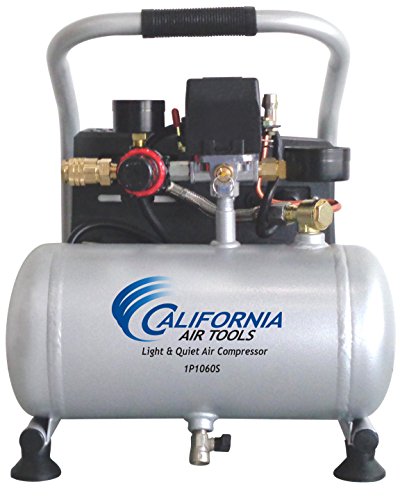
The California Air Tools 1P1060S is a small, light, oil-free air compressor with a 1-gallon steel tank and a 0.6 HP motor. Its main selling point is noise: the maker lists 56 decibels, the lowest figure on this site. It is aimed at people who want air for a nailer, a tire or an airbrush without a loud compressor in the room. This profile covers what California Air Tools publishes, what that airflow can realistically drive and when a larger compressor is the better call. All figures come from the maker’s product page.
According to the product page:
- Motor: 0.6 HP rated and running, 1.2 HP peak, operating at 1680 RPM, with an oil-free single piston pump.
- Tank: 1.0 gallon, steel, and the unit weighs 29 lbs.
- Airflow: 1.60 CFM at 40 PSI and 1.20 CFM at 90 PSI.
- Maximum pressure: 120 PSI.
- Noise: 56 decibels.
- Power: 110V, 60 Hz, a low amp draw of 4.5 A, and a note that a generator of at least 2,000 running watts is needed if you power it that way.
- Fill and recovery: 50 seconds from empty to full, and 15 seconds to recover from 90 to 120 PSI.
- Duty cycle: 70/30, with a maximum continuous run of 30 to 60 minutes depending on PSI and CFM.
- Protection and approvals: thermal overload protector, external current protector, ETL certified.
- Size: 12.5 x 14.7 x 14.75 inches.
- Warranty: 1 year limited.
The maker also says the pump is designed for a long life, quoting more than 3,000 hours compared with 250 hours or less for comparable compressors. That is a manufacturer claim that we cannot verify. Read the warranty, and do not expect the compressor to run all day.
Why Noise Is the Headline
Many compressors for a home garage are loud. The CRAFTSMAN kit on this site is rated 78.5 dBA, and the oil-lubricated Makita Big Bore units are built for job sites. The 1P1060S, at 56 dB per the maker, is meant for a different situation: working indoors, in a garage next to living space or in a workshop where someone else is trying to concentrate. The maker says it is ideal for anyone working inside where noise is a major issue.
A caution about decibel figures: they are measured at a set distance under defined conditions, and a compressor’s noise level can change as tank pressure rises and the pump works harder. The tool you attach, such as a nailer firing, may be louder than the compressor. So “quiet compressor” does not mean a silent job. It means the pump should not be the loudest part of it.
What 1.20 CFM at 90 PSI Can Do
Airflow at 90 PSI is the number to compare against the tool. California Air Tools says the 1P1060S is suited to staple guns, brad nail guns, finish nail guns, airbrushes and blow guns, and to inflating tires, beds, toys and sport balls. That matches how small compressors are typically used: tools that draw air in short pulses, with enough tank to cover a few shots before the pump catches up.
In practice:
- Brad and pin nailers are the best fit. Each shot uses little air, so the pump has time to refill the tank between shots. The Metabo HPT NT50AE2 brad nailer, for example, lists an operating pressure of 70 to 120 PSI, which sits inside the 1P1060S’s 120 PSI maximum.
- Finish nailers can handle light trim at a normal pace, though a 1-gallon tank leaves less margin if you fire quickly. If you plan to trim a whole house, a larger tank is more comfortable. Our guide to choosing a compressor for a nail gun explains how to size it.
- Framing nailers are not a good match for a 1-gallon compressor. Senco lists an 11 SCFM air-consumption entry for its FramePro 751XP, well above this unit’s 1.20 CFM rating.
- Airbrushing calls for steady, low pressure and a quiet compressor, and the maker’s page positions this unit for it. You will want a regulator and moisture trap for fine finish work, and the page lists two pressure control gauges.
- Inflation is fine for car tires, bike tires and balls. With a car tire, a small tank means you will probably wait for refills when filling from flat, which is where a dedicated 12V inflator is easier.
It is not for impact wrenches, die grinders, sanders or paint spraying with a gun. Those tools use air continuously, and a 1-gallon, 1.2 CFM compressor cannot keep up.
Practical Details
Weight and portability. At 29 lbs with a carry handle, it moves easily from a garage to a deck to a spare room. That is a real advantage over the 33.8 lb CRAFTSMAN pancake and the 77 to 88 lb Makita units.
Electrical load. The maker lists a 4.5 A draw, which is lower than the larger compressors on this site. Still, check the nameplate and avoid sharing a circuit with a space heater or other big loads.
Oil-free maintenance. There is no oil to change. California Air Tools asks you to replace the air filter every 2 years, or every year if the compressor is exposed to a dirty or dusty environment. Drain moisture from the tank regularly, as with any tank compressor.
Connection. The page lists one female industrial push-to-connect quick connector. Check that your hose and tool fittings match, since the feature list names no hose. The page shows a 16-piece air hose and accessory kit as a separate item.
Commercial use. The page says commercial use should refer to state and city codes. A compressor this size is generally a home and hobby tool.
How It Compares
Within this site, the 1P1060S sits at the small end:
- Against the CRAFTSMAN CMEC6150K, you give up tank size (1 gallon against 6) and the included kit, and gain a much lower noise rating and a lighter, lower-amp unit.
- Against the California Air Tools 20020, the same maker’s 20-gallon unit, you trade capacity for portability. The 20020 is for tools with sustained demand, and the 1P1060S is for small jobs in tight spaces.
- Compared with a 12V inflator like the VIAIR 400P, it does more, but it is not something you keep in a trunk.
Who It Suits
- A homeowner who wants a quiet compressor for trim, brad nailing and inflation.
- Hobbyists with an airbrush, model work or craft projects indoors.
- Someone with limited storage who needs a compressor they can lift with one hand.
- Anyone who has to run a compressor in a shared space or next to living areas.
Who Should Look Elsewhere
- Anyone running a framing nailer or continuous air tools should pick a larger compressor with more airflow.
- Anyone who wants a deep reserve for long finish-nailing sessions may find 1 gallon limiting.
- Anyone who mostly inflates tires may prefer a purpose-built 12V inflator.
Bottom Line
The California Air Tools 1P1060S makes a clear trade: it gives up tank size and airflow for low noise, low weight and a light electrical load. For brad and finish nailing, airbrushing and inflating, that is a good trade, and its 56 dB rating is the lowest on this site. For shop work with continuous air tools, it is the wrong size. Use the button below to see current pricing on Amazon.
For how it ranks against the other shop compressors, see our air compressor ranking for 2026.
See price on Amazon
Sources